
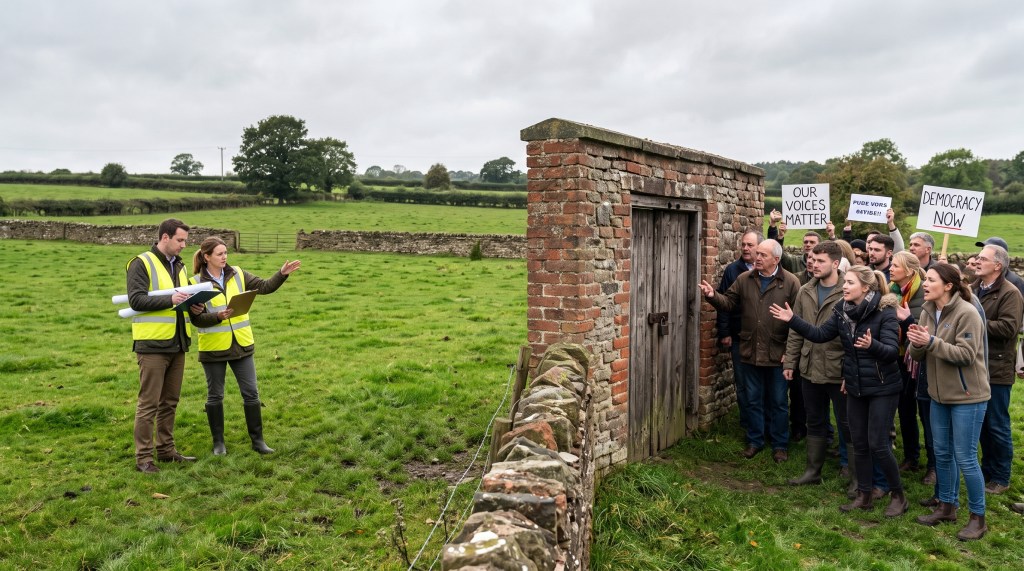
Burntwood residents—we desperately need 5 minutes of your time today.
The consultation deadline for the proposed 225-home development at Land North of Rake Hill (Application 26/00630/OUTM) closes on Monday, 9th November 2026.
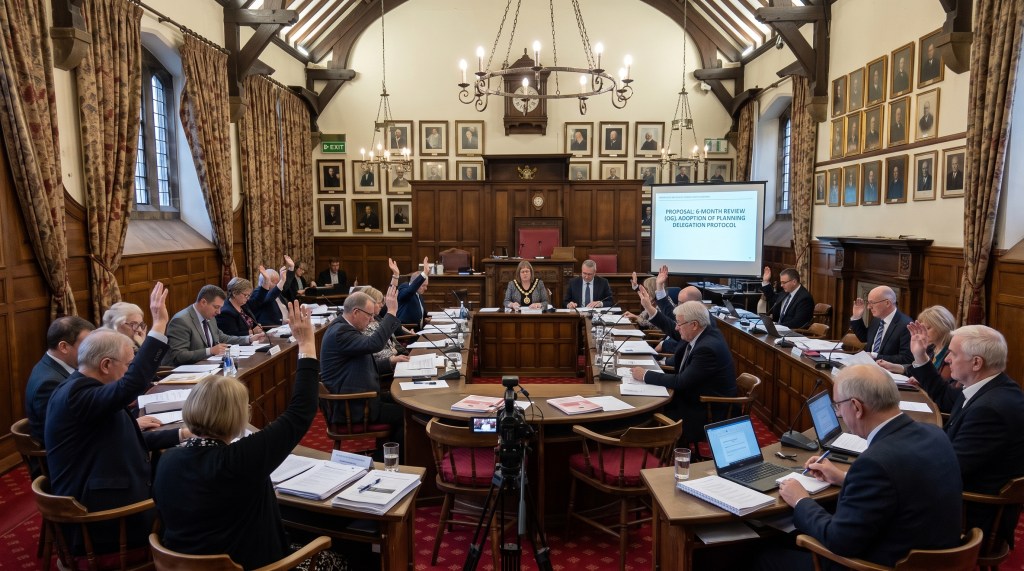
Following a last-minute wave of documents uploaded by the developer on 19th October, coupled with sweeping changes to planning rules that took effect on 31st October 2026, our community faces a major hurdle. Under the new National Scheme of Delegation, local Ward Councillors have lost their automatic right to “call in” controversial applications like Rake Hill to be heard in public by the Planning Committee. Instead, applications under 500 homes now risk being decided entirely behind closed doors by planning officers.
However, there is still a way to force accountability and demand a public hearing—and we need you to contact your Ward Councillors right now to make it happen.
Why Your Email Matters Today
The Burntwood Action Group (BAG) Strategic Policy Team has engineered a comprehensive, ready-to-use legal and policy template for our Burntwood District Ward Councillors (and Burntwood Town Council) to submit before the 9th November deadline.
By asking your Ward Councillor to submit this formal representation, we achieve three critical objectives in a single document:
- Trigger the “Member Response” Box on the Gateway Form: During the Planning Committee briefing, officers confirmed that the Gateway Referral Assessment Form includes a box recording whether a Ward Member response was received, and the Chair specifically recommended that Ward Councillors “put something in substantial so it can be considered.”
- Force Officer Accountability (Even if Delegated): Officers confirmed on the record that where a Ward Member or Town/Parish Council submits written objections, officers must publish them, weigh them in the planning balance, and explicitly answer why they agree or disagree in the final Officer Report.
- Establish Criteria A & B for Public Committee Referral (Including for a Refusal): It formally lobbies the Nominated Officer (Planning & Development Manager) and Nominated Member (Chair of the Planning Committee) under Regulation 5(3), requesting that the application be treated as an “exceptional circumstance” so that—even if officers recommend refusal—the decision and refusal reasons are settled in public by the Planning Committee rather than behind closed doors.
How You Can Help in 3 Easy Steps (Before 9th November!)
- Find Your Burntwood District Ward Councillors: Click here to find your Councillor’s email address on the Lichfield District Council website: 👉 Find Your Ward Councillor Here
- Copy and Paste the Text Below: Copy the Covering Note AND the Template Letter below into an email to your supportive Burntwood District Councillors.
- Fill in the Councillor’s Name and Hit Send! (Remember: Your Councillor must submit their representation before 9th November 2026, so please send this to them as soon as possible!)
COPY & PASTE EVERYTHING BELOW THIS LINE INTO YOUR EMAIL:
Subject: URGENT: Before 9th November – 31st October Delegation Changes — Written Ward Member Representation & Gateway Referral for 26/00630/OUTM (Rake Hill)
Dear Councillor [Insert Councillor Name],
Following the applicant’s 19 October submission on 26/00630/OUTM (Land North of Rake Hill), the Case Officer (Clare Saint) has confirmed that there is currently no confirmed date or procedure for determination.
As the new National Scheme of Delegation took effect on 31 October 2026—removing automatic Ward Member call-in rights—officers and the Chair confirmed during the committee briefing that Ward Councillors must now submit substantial written representations directly onto the application file so that:
- The “Member Response Received” box is ticked on the Gateway Referral Assessment Form;
- Officers must take Ward Member representations into account and address the principal planning issues raised within the Officer Report; and
- The Nominated Officer and Chair of the Planning Committee have a formal written request to refer the application to the public Planning Committee under Statutory Criteria A and B (regardless of whether the recommendation is approval or refusal).
As a local resident, I am asking for your urgent support in submitting a formal representation before the 9th November 2026 deadline. To assist you, the Burntwood Action Group (BAG) Strategic Policy Team has drafted the template representation below incorporating the latest August 2026 NPPF technicalities and the October consultation updates. Please feel free to adapt it into your own words.
Submission details for Councillors: Send to the case officer through the existing correspondence address, clare.saint@lwmts.co.uk, and copy devcontrol@lichfielddc.gov.uk (and neighbour.responses@lichfielddc.gov.uk). Ask Development Management to forward the representation and referral request to the Council’s nominated officer and nominated member. Quote 26/00630/OUTM in the subject line.
The following letter is for an elected district ward councillor. Replace the bracketed name and ward details and retain only statements you adopt. The policy and evidence references at the end can accompany the letter.
Thank you for standing up for Burntwood residents,
[Your Name] [Your Address / Postcode]
TEMPLATE LETTER FOR WARD COUNCILLORS TO SUBMIT
To: Clare Saint, Case Officer — clare.saint@lwmts.co.uk Cc: devcontrol@lichfielddc.gov.uk; neighbour.responses@lichfielddc.gov.uk; Chair of the Planning Committee (Nominated Member); Planning and Development Manager (Nominated Officer) For onward circulation to the nominated officer and nominated member for committee referral
Subject: FORMAL WARD MEMBER OBJECTION AND COMMITTEE REFERRAL REQUEST — 26/00630/OUTM
Dear Ms Saint,
Application 26/00630/OUTM — Outline application with all matters reserved except access for demolition, residential development of up to 225 dwellings, open space, associated works and infrastructure at Land North of Rake Hill, Burntwood
I write as an elected District Ward Councillor for Burntwood to object formally following the applicant’s material published on 19 October 2026. I request refusal and formal consideration of referral to Planning Committee.
Please publish this representation on the application record, record it as a ward member response and committee referral request in the applicable assessment, and explain the Council’s conclusions on the principal material planning issues in the officer report.
PART 1: FORMAL REQUEST FOR PLANNING COMMITTEE CONSIDERATION
Under regulation 5(3) of the Town and Country Planning (Discharge of Local Planning Authority Functions) (England) Regulations 2026, I ask the nominated officer and nominated member to agree referral of this Schedule 2 application to Planning Committee. I consider that the following matters justify referral under both statutory criteria, recognising that referral requires their agreement. [R1–R2]
Criterion A: Significant local economic, social and environmental issues The proposal would introduce up to 225 homes into open countryside at Burntwood’s edge. Its significance extends across the National Landscape setting, recreational pressure on Gentleshaw Common SSSI, historic farmstead and listed-building settings, constrained rural roads, drainage and neighbouring residents. The interaction between these effects, infrastructure requirements and cumulative development pressures warrants committee scrutiny.
Criterion B: Significant planning matters The application raises contested Green Belt and grey-belt issues, acknowledged listed-building setting harm, the adequacy of ecological and designated-site assessment, safe and sustainable access, and the ability to accommodate the maximum development with its mitigation. The Council’s Article 15 site notice records departure wording; this proposal for up to 225 dwellings “does not accord with the provisions of the development plan in force” and affects the setting of a Listed Building.
The officer report should identify the actual development-plan conflicts and address the separate statutory and policy tests; the notice does not settle those judgements.
The scale of the proposed outline permission also makes scrutiny at this stage important. Reserved matters under an outline permission below the 500-home threshold would normally be officer-determined under the national arrangements, subject to any applicable exceptions. This substantially reduces future opportunities for committee scrutiny, although public and councillor representations remain possible.
I request referral even if officers recommend refusal, to allow public consideration of the significant planning issues and proposed refusal reasons. Please exercise any available discretion within the applicable delegation arrangements. If referral is not agreed, please record the decision and its reasons, including the assessment of the criteria and this representation.
PART 2: SUBSTANTIVE PLANNING GROUNDS SUPPORTING REFUSAL
I support the material evidence in Burntwood Action Group’s (BAG’s) original technical-note suite (BAG-R01, BAG-R02-03, BAG-RFTN-01 to 09), the transport updates including RFTN-04C, the Rebuttal to Hourigan and its evidence-review appendices, the Photographic Evidence and the RFTN-09 October Update. The Council should assess these together with the applicant’s original and revised evidence. Housing need is a material consideration, but it does not dispense with the separate heritage, ecological, transport and Green Belt tests.
A housing shortfall is not a licence to approve harmful development. Whatever position the Council ultimately takes on its district-wide five-year housing land supply, that shortfall does not displace the statutory duties or remove the need to satisfy the applicable heritage, habitats and Green Belt policy tests. BAG considers that the submitted evidence fails to demonstrate compliance with those requirements and that the claimed housing benefits do not justify the identified harm. I therefore urge the Council to REFUSE application 26/00630/OUTM on the following grounds:
1. Green Belt harm and the contested grey belt gateway route I consider that the permanent outward extension of development and inadequately demonstrated containment conflict with Core Policies 1, 3 and 6 and Policy NR2. Compliance with GB7(1)(g), including grey-belt status, sustainable location and GB8, has not been demonstrated. The Annex E assessment should examine the actual settlement edge, slope and claimed containing features, distinguishing the Green Belt purposes relevant to the grey-belt definition from the wider harm to openness and countryside encroachment.
If no GB7 category applies, GB6 requires very special circumstances; I consider the harm has not been clearly outweighed. GB8(1)(b) requires necessary infrastructure improvements and GB8(1)(c) accessible green space. Illustrative provision does not demonstrate compliance. [N1; BAG RFTN-01 and RFTN-09]
2. Highway safety, access and sustainable transport SCC Highways’ earlier recommendation was refusal. Please confirm its current operative position on the October material and BAG-RFTN-04C; the published September records should not be assumed to establish a fresh assessment. Access is for determination now. The unresolved issues concern constrained roads, route assignment, the Castle Farm bend and safe, inclusive onward journeys from the PRoW exits, including school routes along Meg Lane and Rake Hill without continuous footways.
An internal footpath network does not answer those onward safety concerns. TR3, TR4 and TR6, Core Policy 5 and Policy ST1 require a substantive transport assessment; ST2 is relevant to parking provision. Burntwood’s transport score of 12/40 in the Council’s 2024 study provides context alongside the site-specific evidence. I consider the unresolved access and sustainable-travel concerns support refusal. [N2; BAG RFTN-04 suite]
3. Listed building setting, landscape and topography The applicant acknowledges harm to the listed-building settings at 32–34 Rake Hill. Section 66(1) requires special regard to preservation; HE4–HE7 and Core Policy 14, BE1 and BE2 require the appropriate heritage judgements, with separate assessment of non-designated assets. The revised layout does not demonstrate protection of the historic rural setting or countryside-facing slope, including effects from built form, lighting and recreation.
The Council’s own historic-environment evidence identifies Castle Farm’s origins in at least the early 18th century. The Lichfield District Historic Environment Assessment, February 2009, Appendix 4: Burntwood, BHECZ 9—North of Burntwood (HECA 10b), records those origins on page 42 and identifies the protection of unlisted historic buildings, dispersed settlement and associated landscape character as development considerations on pages 41–43. Although it acknowledges historic field-boundary removal around Castle Farm, the assessment identifies the wider zone as highly sensitive to medium and large-scale development. The Council should therefore expressly assess how the proposed housing, lighting and boundary recreation would affect Castle Farm’s significance and surviving rural setting under Core Policy 14 and Policies BE2 and NR5. Retaining the farmhouse does not, by itself, demonstrate conservation of its historic relationship with the surrounding countryside. [H1]
The Cannock Chase National Landscape Partnership expressly objected on 15 July 2026 (1239216), identifying permanent replacement of transitional countryside by suburban development. Hedges, planting and open space may soften development without preserving that countryside function. Core Policy 13 and NR5 also require assessment of this landscape harm. Please obtain an explicit response to the October revisions; neither withdrawal nor renewed confirmation of the earlier objection is assumed. I consider the identified heritage and landscape harms remain unjustified. [N3; BAG RFTN-03; Rebuttal Appendix D]
4. Ecology, biodiversity and designated site assessment The published March biodiversity statement records an on-site habitat-unit loss of 17.65 units (19.69%), from 89.64 to 71.99 units, with the claimed overall gain dependent on off-site enhancement. These are March figures, not a recalculation of the October scheme: a reconciled metric and plans should establish the revised loss, mitigation hierarchy and secure delivery. Off-site units do not themselves resolve protected-species impacts or designated-site disturbance.
Retaining H18 does not answer survey gaps concerning demolition buildings, other hedges, trees and connected habitats, barn-owl evidence or dark routes. LDC Ecology’s response published 10 August (1244232) regarded the open-space and information-pack package as insufficient in itself, concurring with Natural England’s concern. Natural England’s 10 June letter (1229298) rejected packs alone and sought additional Gentleshaw Common SSSI mitigation. The revised package must demonstrate an effective answer under Core Policy 13 and NR3, NR4, NR6 and NR7.
LDC Ecology’s acceptance of the Cannock Chase SAC contribution mechanism did not resolve the distinct SSSI concern. For the SAC, the competent authority should address the shadow HRA, in-combination effects and mitigation security; where appropriate assessment is required, it must be satisfied beyond reasonable scientific doubt that site integrity would not be adversely affected. I consider the unresolved baseline, impact-assessment and mitigation deficiencies support refusal. [R3; BAG RFTN-02; Rebuttal C1–C4 and Appendices E–F, including S5]
5. Surface water drainage and protection of lower properties The maximum scheme requires a workable strategy for discharge, storage, exceedance routes, maintenance and protection of the brook and lower properties, addressing residents’ surface-water, groundwater and flooding evidence. Staffordshire’s LLFA response of 27 July (1241103) refers back to earlier requirements; please identify their resolution and the authority’s current position.
LDC’s Arboricultural Officer (1243763) warns that services and drainage can prevent strategic planting, require additional open space and affect realistic dwelling capacity. Drainage must therefore be reconciled with root protection, habitat buffers and recreation under Core Policy 3 and BE1. An indicative drainage annotation does not establish that these competing requirements can be accommodated safely. I consider the unresolved feasibility and protection of lower properties support refusal. [BAG RFTN-05; Rebuttal C9 and Appendix D, L04]
6. Amenity, security, lighting and incompatible site pressures The retained exercise facilities and paths near Castle Farm’s boundary intensify privacy, disturbance and security concerns because of the ground-level differences and proximity to the home and outbuildings. Duncan Fisher’s Staffordshire Police advice of 5 June (1228834) seeks surveillance of paths and open space and reproduces guidance against paths behind gardens. This is design advice rather than a refusal recommendation, but its lighting and visibility requirements require reconciliation with dark bat corridors, residents’ privacy and the claimed heritage buffer.
John Mills, LDC Environmental Health, reported on 18 August (1246566) that his initial concerns had not been addressed. He sought representative assessment of farm activities, busy operating periods and relevant odour and fly effects. The October operator letter concerning Mostel Lea Farm requires assessment against those concerns. Under Core Policies 3 and 10, BE1 and NR3, I consider the proposal has not demonstrated compatible amenity, security and ecological protection at the maximum scale. [BAG RFTN-06; Rebuttal C6 and C8, section 4 and Appendices D–F; Photographic Evidence]
7. Infrastructure, cumulative effects and delivery Core Policies 3, 4 and 10, IP1, HSC1 and Burntwood 2 require assessment of infrastructure, healthy communities and open-space provision. Utility requirements and cumulative pressures on roads, schools, healthcare, drainage and recreation must be assessed alongside the land and delivery arrangements needed for mitigation. The same space cannot simply be credited to every obligation; intended facilities or contributions do not demonstrate the maximum scheme’s physical feasibility or secure delivery.
The separate BAG District Housing Challenge seeks reconciliation of supply and delivery assumptions; it does not count pending, screening-stage or refused proposals as deliverable homes. I consider the combined harm supports refusal even if a housing shortfall remains. [N1–N2; BAG RFTN-07; District Housing Challenge]
PART 3: MATTERS TO ADDRESS BEFORE DETERMINATION
- Identify the relevant development-plan conflicts and policy weights, including the heritage policies, and explain the applicable Green Belt and overall planning balance.
- Assess the earlier decision relating to 11/00496/COU and appeal APP/K3415/A/11/2159504. The appeal decision is listed on the portal as document 1256521. Consider its enduring site findings proportionately, distinguishing the former proposal and access from the current scheme.
- Confirm and publish the current positions of SCC Highways, ecology, Natural England, the National Landscape team, the flood authority and Environmental Health on the October material and relevant BAG evidence. Identify outstanding advice and explain how the principal issues have been assessed.
- Please distinguish a formal objection or recommendation of refusal from advice seeking information, a conditional no-objection and an absent response. For each unresolved specialist concern, identify the document relied upon, whether it addresses the October scheme and the evidence said to resolve it. An applicant’s assertion that a concern has been answered is not a substitute for the Council’s reasoned specialist assessment.
- Reconcile the framework, landscape, ecological, heritage, drainage and amenity requirements within the same maximum development proposal, including effects at Castle Farm and other boundary properties.
- Confirm the outcome of this committee referral request, the reasons for that outcome and the anticipated determination timetable. Allow a reasonable opportunity for representations on materially revised evidence or advice.
I request refusal on the substantive planning evidence and ask that the significant issues identified above receive public committee scrutiny through the applicable referral process.
Yours sincerely,
Councillor [Name] District Councillor for [Ward] Lichfield District Council
Policy and evidence references:
- R1: Government statutory guidance, Planning Committees and the National Scheme of Delegation of Planning Functions, 1 June 2026: paragraphs 7, 9–15, 18–24 and 27–29; regulation 5(3) referral criteria.
- R2: LDC, Planning changes — what you need to know.
- R3: Conservation of Habitats and Species Regulations 2017, regulation 63.
- N1: NPPF 2026, GB6, GB7(1)(g), GB8 and Annex E.
- N2: NPPF 2026, TR3, TR4 and TR6.
- N3: NPPF 2026, HE4–HE7 and Annex A; section 66(1), Planning (Listed Buildings and Conservation Areas) Act 1990.
- H1: Staffordshire County Council, Lichfield District Historic Environment Assessment, February 2009, Appendix 4: Historic Environment Character Zone Assessments—Burntwood, BHECZ 9—North of Burntwood (HECA 10b), printed pages 41–43, particularly page 42 recording Castle Farm’s origins in at least the early 18th century.
- Portal document register checked 30 October 2026. The consultation expiry shown was 9 November 2026. BAG’s detailed evidence and source registers are in the Rebuttal to Hourigan and the RFTN suite.


Leave a Reply