
Following Lichfield District Council’s vote to adopt the government’s National Scheme of Delegation for Planning Functions, the Burntwood Action Group has been in direct contact with Councillor Steve Norman, Chair of the council’s Overview and Scrutiny Committee.
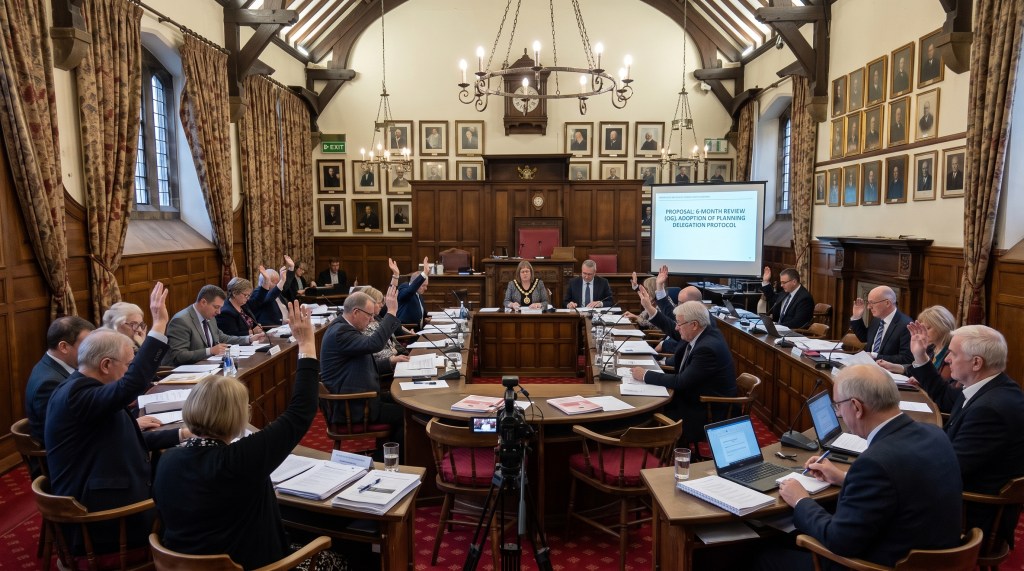
Between the council chamber debate and correspondence with Councillor Norman, we now have a clear picture of the legal constraints the council faced, the crucial six-month review secured on the floor, and the exact scoring criteria officers will use to decide whether developments get a public committee debate or are decided behind closed doors.
Here is what took place, what was agreed, and what it means for how our community must challenge future planning applications.
1. What Happened at the Meeting: Securing the Review
During the council debate, Councillor Norman addressed the reality facing local planning authorities: planning is quasi-judicial, and councils must operate strictly within the law. Acknowledging that local authorities cannot unilaterally override primary legislation without risking costly legal challenges, he formally moved a binding amendment from the floor:
“I also propose… formally now that the council reviews the operation of the new planning rules in six months’ time when existing members, particularly those on the planning committee, can give their views ready for the new council after May next year… It’s really a matter of reviewing it, see if things could be improved.”
Burntwood Councillor Darren Miles intervened immediately, proposing that this formal six-month review be conducted specifically by the Overview and Scrutiny Committee, ensuring all supporting evidence is evaluated.
Councillor Norman accepted the adjustment on the spot, and the amendment passed with overwhelming support before the main delegation paper was approved.
2. Behind the Scenes: The Reasoning from Cllr Norman
In correspondence following the meeting, Councillor Norman clarified the legal landscape and outlined how the review will function:
- Why Council Hands Were Tied: Community suggestions to outright block the rules could not proceed because council legal officers confirmed they would not comply with statutory national legislation.
- The Route to Change: Councillor Norman explained his strategy for the Overview and Scrutiny review: “As it will be my committee that will do the reviewing, that is my plan: an opportunity to review the procedures at LDC and so make changes that still comply with the legislation, or if there were fundamental issues with the legislation, then our Members of Parliament should be asked to press the government for changes.”
- Officer-Backed Transparency Rules: To prevent decisions from vanishing into a black box, Councillor Norman drafted and submitted a three-page protocol of definitions to guide officers and the public on the “Gateway” process. Council planning and legal officers have supported this framework, with detailed formal guidance scheduled for publication at the end of the month.
3. The New Rulebook: What Gets to Committee (and What Doesn’t)
Councillor Norman’s three-page protocol defines how applications will be triaged. For community action groups, this document contains both critical warnings and vital tools.
Under Section 2 of the protocol (Matters Which Do Not Automatically Satisfy the Gateway), the following factors do not automatically trigger a referral to the Planning Committee:
- The sheer number of public objections or representations received.
- The strength of local community opposition or support.
- The fact that a ward councillor has expressed a view.
- The fact that a petition has been submitted.
- The fact that an application is politically sensitive or highlighted in the media.
A petition signed by hundreds of residents will no longer automatically bring an application before elected councillors.
The Toolkit: The Triggers That DO Engage the Gateway
To push a contentious Burntwood application through the Gateway and into a public committee hearing, community representations must align directly with the criteria laid out in Sections 1, 3, and 4 of the protocol:
- Departures from the Development Plan: Applications that substantially conflict with the Local Plan or propose development in protected Open Land or the Green Belt.
- Infrastructure Strain: Substantial impacts on local infrastructure, including school capacity, healthcare facilities, roads, and traffic networks.
- Environmental & Ecological Harm: Significant issues relating to flood risk, drainage, protected trees, biodiversity loss, or local air quality.
- Unresolved Consultee Objections: Major objections from statutory consultees (such as the Environment Agency, Coal Authority, or Highways) that have not been adequately resolved.
- Finely Balanced Planning Judgments: Applications where the planning balance is finely poised and carries significant local consequence.
4. Community Expectations: How We Move Forward
The traditional playbook—waiting for a planning committee date and rallying a crowd to make speeches on the night—is no longer viable for most applications.
- Submit Material Evidence Early: Every objection submitted by residents must rely on hard planning grounds (traffic safety, infrastructure deficit, drainage, Green Belt harm) rather than generic opposition, directly hitting the Section 1 and 3 Gateway criteria.
- Work with Burntwood Town Council: Parish and town councils remain statutory consultees. Generating formal, technical responses at the local council level early in the consultation process provides the paper trail officers must evaluate.
- Build the Dossier for Month Six: The Overview and Scrutiny Committee’s six-month review will be our formal platform to hold the new system to account. We will be logging every Burntwood application, noting how officers applied the gateway test, and collecting evidence on whether community concerns are being bypassed.
We thank Councillor Norman for his engagement, for providing transparency on the Gateway criteria, and for establishing an official review process. We will share the council’s finalised planning guidance as soon as it is published at the end of the month.




Leave a Reply