
A quiet revolution is underway in the English planning system, and its ripple effects have arrived directly on our doorstep.
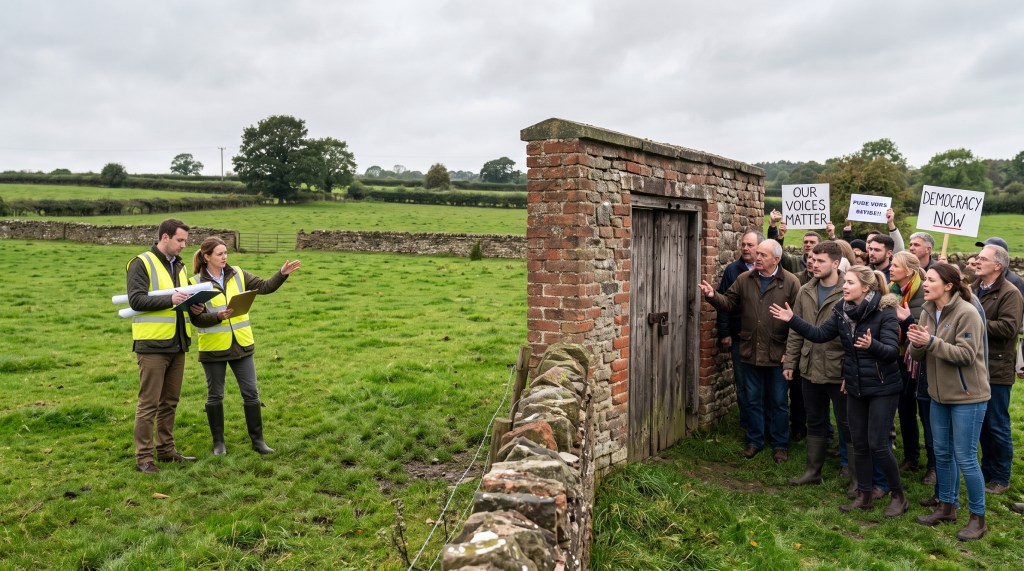
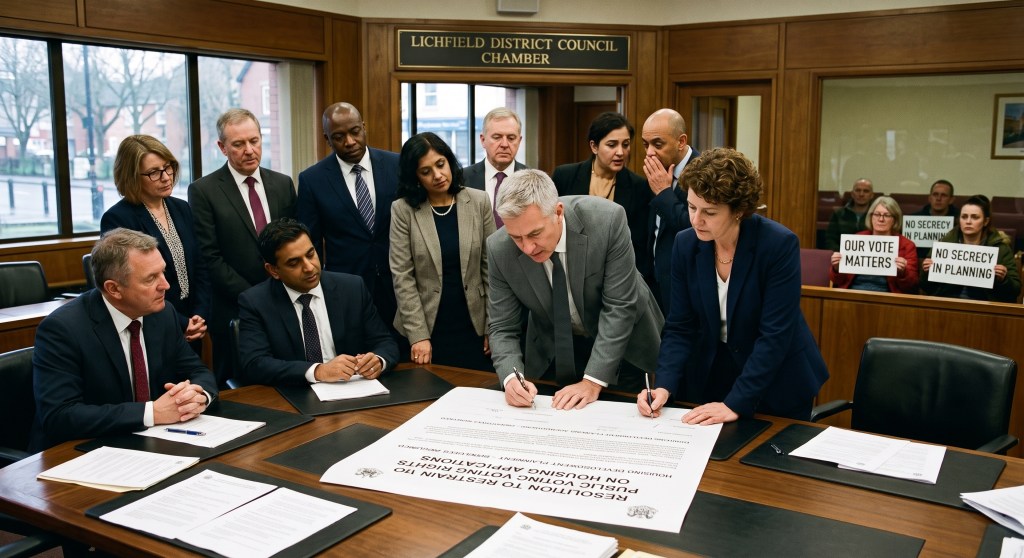
At a recent meeting of Lichfield District Council, elected members debated and ultimately approved constitutional changes to align the district with central government’s new National Scheme of Delegation for Planning Functions. Beneath the dry, procedural terminology lies a profound shift in local governance: the stripping back of councillors’ powers to challenge developments, the sidelining of public committee debates, and a substantial transfer of decision-making authority into the hands of unelected planning officers.
For Burntwood—where green spaces and community boundaries remain under relentless development pressure—the implications could not be more significant.
The Vote: A Silent Rebellion in the Council Chamber
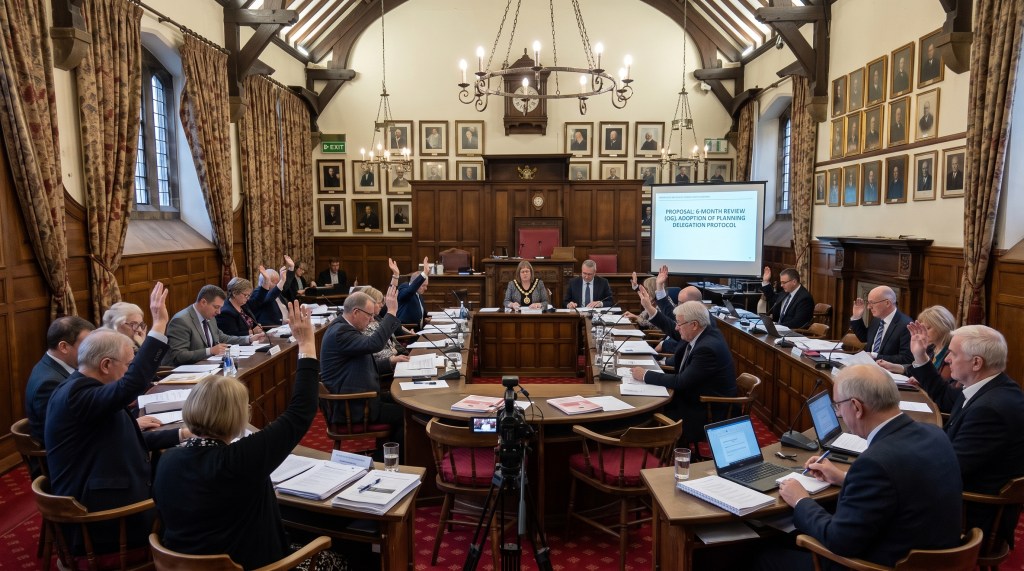
The mood inside the council chamber was defined not by enthusiasm, but by collective resignation. When the motion came to a vote, the final tally told the entire story:
- 16 in favour
- 0 against
- 21 abstentions
Not a single councillor voted against the policy, yet more than half the chamber refused to endorse it.
Speaker after speaker across party lines condemned the legislation, describing it as an erosion of localism and a centralisation of power designed to push through national housing quotas. However, legal advice provided to the council left members cornered: the scheme is statutory national legislation. Had the council refused to adopt it, every future planning decision would have been left vulnerable to costly judicial reviews, and the authority risked being placed into special measures—a move that would have stripped the council of its planning powers entirely.
Three Key Changes Every Resident Needs to Know
The updated constitution introduces sweeping changes to how planning applications are handled across the district:
1. The Death of the Councillor “Call-In”
For years, one of the most vital democratic tools available to a ward councillor was the “call-in.” If an application sparked widespread community concern, a councillor could formally require that the decision be taken out of officers’ hands and debated publicly before the Planning Committee.
Under the new scheme, that unilateral right has been abolished. Councillors can no longer ensure that contentious applications are heard in public.
2. The Officer-Led “Gateway Test”
Decisions will now be heavily triaged:
- Schedule 1: Minor and standard applications are automatically delegated to planning officers.
- Schedule 2: Presumed to be delegated to officers unless an application meets an exceptional threshold of economic, environmental, or social significance.
Whether a Schedule 2 application ever reaches the public committee depends on a strict “gateway test” overseen by the Head of Planning and the Chair of Planning. If planning officers recommend an application for refusal, it cannot be referred to committee under any circumstances.
3. A Downsized Planning Committee
The Planning Committee itself is being reduced from 15 members to 13, shrinking the pool of elected representatives scrutinising major district applications.
Why This Matters: The Ghost of Coulters Lane
To understand the real-world impact of these reforms, one only needs to look at the recent battle over Coulters Lane.
In that case, developers sought outline planning permission to build 250 houses on Green Belt land. Crucially, council planning officers had examined the proposal and recommended it for approval.
It was only because hundreds of residents mounted a concerted campaign, and local ward members fought to bring the matter before the Planning Committee, that the committee rejected the officers’ recommendation and voted to protect the site.
Under the new National Scheme of Delegation, getting an application like Coulters Lane in front of a committee will be an uphill struggle. Councillors pointed out during the debate that planning officers—conscientious as they may be—are not infallible. By removing the public committee backstop, the unique local insight that residents and ward members bring to the table is effectively silenced.
The Six-Month Window: Overview & Scrutiny Review
There was, however, one critical concession won during the debate.
An amendment proposed by Councillor Norman and backed by Burntwood councillor Darren Miles was formally adopted: Lichfield District Council’s Overview and Scrutiny Committee will conduct a thorough review of the new system in six months’ time.
This review will evaluate how the gateway test has functioned in practice, examine whether public concerns are being marginalised, and provide a formal evidentiary record for the newly constituted council after May.
How Community Action Must Adapt
The rules of engagement have changed, and local campaigning must evolve alongside them. Waiting until an application is about to be decided before lobbying councillors is no longer an option.
Moving forward, the primary battleground will be the statutory consultation window:
- Engage at Day One: As soon as an application is registered on the planning portal, objections must be filed immediately.
- Focus on Material Planning Considerations: General opposition or petitions carry little weight with delegated officers. Submissions must be evidence-driven—focusing on highway safety, infrastructure strain, statutory Green Belt protections, environmental ecology, and development plan conflicts.
- Coordinate Through Parish and Town Councils: Burntwood Town Council remains an essential statutory consultee. Working closely with local representatives in the earliest phases is now the most effective way to shape officer appraisals before an application reaches the gateway.
The door to the committee room may be harder to open, but community scrutiny remains as essential as ever. Keep engaging, keep watching the weekly planning lists, and make your voice heard early.





Leave a Reply