
EXECUTIVE SUMMARY
On Monday, 17 August 2026, the Ministry of Housing, Communities & Local Government (MHCLG) officially adopted and published the revised National Planning Policy Framework (NPPF), alongside the newly released 2025 Housing Delivery Test (HDT) measurements and a targeted ministerial statement on Station-Led Homes.
This briefing note has been prepared by our Strategic Policy Team to evaluate how these three major policy shifts alter the material planning balance for the pending appeal regarding Land at Coulter Lane Farm (Application Ref: 25/01485/OUTM).
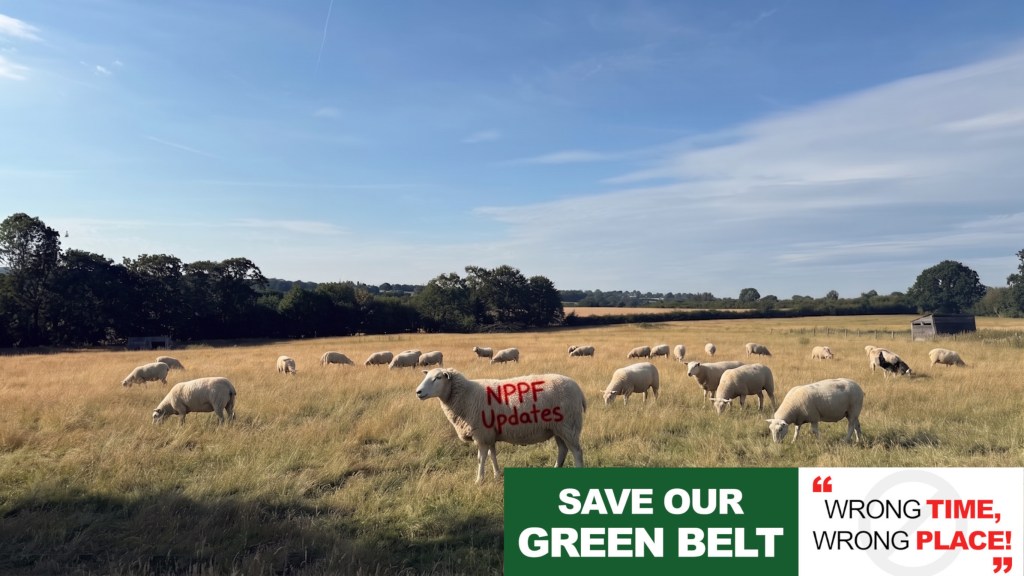
While these updates provide significant new technical arguments for our independent Rule 6 legal defence, we must emphasise that they do not represent an automatic veto or a guaranteed victory. A planning appeal is a highly rigorous, formal judicial proceeding. To successfully defend our landscape boundary, we require the continued active engagement, vigilance, and financial support of our community to secure specialist legal representation on the inquiry floor.
Below, we deconstruct the four critical pillars of today’s reforms, presenting both a Community Summary (the immediate local implication) and a Technical Planning Assessment (the formal policy framework) for each.
1. THE REVISED “GREY BELT” DEFINITION (NPPF ANNEX 2)
The Community Summary
The Government’s revised framework clarifies that Green Belt land cannot be classified as “Grey Belt” simply because a developer proposes a high-density scheme. To meet the new “Grey Belt” criteria, land must be proven to make a negligible or weak contribution to Green Belt purposes. Because our fields have been officially rated by the local authority as making a high-performing contribution to checking urban sprawl and preventing encroachment, the site is excluded from this backdoor reclassification.
The Technical Planning Assessment
Under the adopted Annex 2 glossary of the 17 August 2026 NPPF, “Grey Belt” is defined as previously developed land or greenfield land that does not strongly contribute to any of Green Belt purposes (a), (b), or (d) set out in Paragraph 143. Crucially, the definition explicitly states that Grey Belt excludes land where the application of policies relating to the areas or assets in Footnote 7 (which includes designated heritage assets and areas at risk of flooding) would provide a strong reason for refusing development.
The material evidence base on the active casework file renders a Grey Belt classification legally unsustainable for the Coulter Lane parcel:
- The Encroachment Criterion (Purpose c): The newly adopted Staffordshire Green Belt Assessment 2026 explicitly classifies our specific parcel (BUR06) as making a “Strong Contribution” to safeguarding the countryside from encroachment.
- The Sprawl Criterion (Purpose a): During the committee determination on 20 July 2026, the Planning Committee formally resolved that developing these fields would result in unrestricted urban sprawl, confirming the land strongly contributes to Purpose (a).
- The Little Aston Precedent (Consistency Duty): In LDC’s signed Refusal Notice for Little Aston (Application Ref: 26/00425/OUTM), officers ruled that a site making a “Strong Contribution” to Purpose (a) is definitionally disqualified from Grey Belt classification. Under established public law, the authority must apply this technical standard consistently across the district.
2. THE HOUSING DELIVERY TEST SHIELD (209% PERFORMANCE)
The Community Summary
Developers frequently attempt to argue that local planning protections should be ignored because a council has failed to build enough houses. However, the newly published national figures show that Lichfield District is actually one of the top-performing housing delivery areas in the country, building more than double its national requirement. This means there is no systemic local housing emergency to justify bypassing our local development plan.
The Technical Planning Assessment
The 2025 Housing Delivery Test (HDT) results published on 17 August 2026 officially record that Lichfield District Council has achieved an extraordinary HDT measurement of 209%, successfully delivering 2,043 net additional homes against a statutory requirement of 975 over the three-year monitoring period (FY 2022/23, 2023/24, and 2024/25).
- No Statutory Sanctions: Because LDC’s delivery rate is far above the 85% threshold, the council is not subject to any housing delivery penalties or mandatory action plans under the national framework.
- A Temporary Administrative Deficit: While the council currently lacks a five-year housing land supply (HLS)—sitting at 3.5 years—this deficit is not due to delivery failure. It is a temporary administrative transition caused by LDC’s formal decision to initiate a 30-month delay to adopt its updated Local Plan under the emerging 2026 Regulations.
- The Planning Balance: At the upcoming Public Inquiry, our barrister will use the 209% HDT score to demonstrate that the temporary 3.5-year supply gap carries very limited weight in the overall planning balance, and cannot be used to justify overriding severe highway safety conflicts or hydrological risks.
3. STATION-LED HOMES POLICY: LAND IN A TRANSPORT VACUUM
The Community Summary
The Government’s landmark statement, “Full steam ahead to fast-track more homes near stations,” introduces a presumption in favour of housing specifically around well-connected train, tram, and underground stations. This policy is designed to encourage public transport use and actively protect our open countryside. Because Coulter Lane has no rail connectivity and sits in a transport vacuum, it represents the exact opposite of what this policy is trying to achieve.
The Technical Planning Assessment
The new ministerial statement and accompanying NPPF updates restrict the default “yes” to housing and minimum density uplifts to “underdeveloped land within reasonable walking distance of well-connected train, tram, and underground stations.”
- Locational Unsustainability: The application site is a car-dependent greenfield boundary located miles from the nearest railway station (Blake Street) and lacks any bus services within a 1-mile radius.
- The Highway Safety Obstruction: The developer’s proposal to route a diverted 12-metre public bus through Church Road directly conflicts with Staffordshire Police Enforcement Log #682898236, which officially records active emergency vehicle immobilisation and pavement-mounting along this narrow primary school corridor. Under NPPF Paragraph 115, development must be refused where the impact on highway safety is unacceptable. Today’s policy statement actively reinforces our Green Belt defence by confirming that speculative, car-dependent edge-of-settlement sprawl remains unsustainable.
4. THE MANDATORY HERITAGE BALANCE (NPPF FOOTNOTE 7)
The Community Summary
The Council’s technical officers have already admitted that building a 250-home estate will cause permanent, irreversible harm to the open rural setting of the Grade II listed Fulfin Cottage and Fulfen Farmhouse. Under the adopted NPPF, any harm to a listed building’s setting—no matter how minor—legally switches off the standard presumption in favour of development, meaning housing targets cannot be used to excuse the destruction of our heritage.
The Technical Planning Assessment
Under NPPF Paragraph 11(d)(i) and Footnote 7, the “tilted balance” in favor of development is automatically completely disengaged where policies in the Framework protecting designated heritage assets provide a clear reason for refusal.
- Admitted Setting Harm: The Case Officer’s report for Application 25/01485/OUTM officially records that the development will cause permanent, unmitigated “less than substantial harm” to the historic setting of Fulfin Cottage and Fulfen Farmhouse.
- The Wrotham Precedent: Under the binding High Court authority in Wrotham (firmly locked into the 17 August 2026 framework), any level of harm to a designated asset’s setting disengages the tilted balance.
- Restoring Local Plan Authority: Once the tilted balance is disengaged, the district’s housing supply deficit is rendered irrelevant. The planning balance reverts to a flat balance, restoring full statutory force to LDC’s adopted Local Plan environmental policies CP14 and BE1 to mandate a refusal.
THE STRATEGIC OUTLOOK: WHY WE NEED YOUR CONTINUED SUPPORT
The adoption of the revised NPPF has provided our legal team with a highly precise, evidence-led planning framework to defend Burntwood’s landscape boundary.
However, we must be absolutely clear: the developer, Bloor Homes, is backed by immense corporate resources and will deploy experienced legal counsel to argue their case at the upcoming Public Inquiry.
To successfully deploy these newly adopted policies on the inquiry floor, we must have our own specialist planning barrister, standing on equal footing to cross-examine their witnesses and protect our town. This requires our community’s continued financial support, vigilance, and active presence.
Let’s keep our focus clear, our evidence rigorous, and “SAVE OUR GREEN BELT” signs standing tall. We have the technical evidence—now we must work together to deliver the defence.
The Burntwood Action Group (BAG) Strategic Policy Team
Inspiring a Better Burntwood





Leave a Reply