
By the Burntwood Action Group Strategic Policy Team
Grab a cuppa, Burntwood. We need to talk about what’s happening behind the closed doors of the Lichfield District Council (LDC) planning department.
If you’ve been following our campaign to protect the historic fields of Coulter Lane (Application 25/01485/OUTM), you’ve probably heard some version of the Council’s favorite song: “We have a housing shortfall, our hands are tied, and we must accept speculative developments on our Green Belt.”
But on 23rd July 2026, LDC signed and sealed a document that completely shatters that narrative.
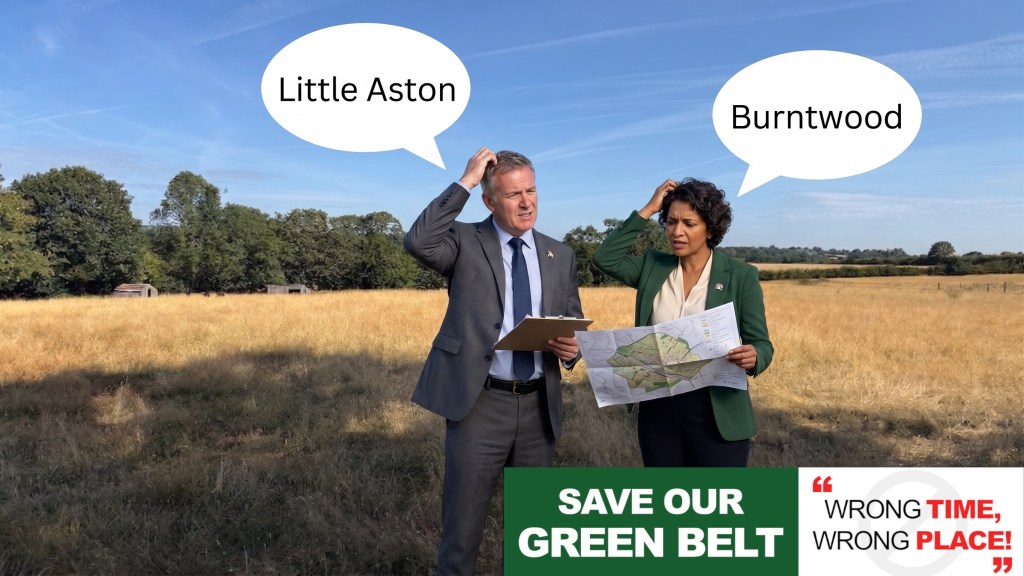
The Council issued a formal, binding Refusal of Outline Planning Permission for up to 100 homes on Green Belt land west of Roman Lane, Little Aston (Application 26/00425/OUTM). When we compared the Little Aston Refusal Notice with the Officer’s Report recommending approval for 250 homes in Burntwood, we uncovered a system of screaming double standards.
It turns out LDC knows exactly how to enforce the National Planning Policy Framework (NPPF) to protect the countryside—they just only seem to do it when the postcode is in Little Aston.
Here is the forensic breakdown of the five fatal double standards LDC is using to protect Little Aston while preparing to pave over Burntwood.
1. The “Grey Belt” Magic Act: One Rule for Them, Another for Us
Let’s start with the developers’ favorite new loophole: the “Grey Belt.”
Under national policy, Grey Belt is strictly defined as previously developed land or greenfield sites that make a weak or moderate contribution to the Green Belt. It explicitly excludes any land that strongly contributes to Green Belt purposes.
In refusing the Little Aston application, LDC’s Case Officer, Frank Whitley, was refreshingly blunt:
“The application site strongly contributes to purpose (a) of the Green Belt, that being to check the unrestricted sprawl of large built-up areas… The application site is not therefore grey belt land according to the NPPF definition.”
- The Little Aston Rule: If a site “strongly contributes” to a Green Belt purpose, it is definitionally disqualified from being Grey Belt. It remains inappropriate development, meaning it cannot be approved unless the developer demonstrates “Very Special Circumstances” (VSCs).
- The Burntwood Double Standard: LDC’s own newly published 2026 Staffordshire Green Belt Assessment officially grades our Coulter Lane parcel (BUR06) as making a “Strong Contribution” to Green Belt Purpose (c) (safeguarding the countryside from encroachment). Furthermore, at the 20 July committee meeting, the Planning Committee formally resolved that the Coulter Lane development would constitute unrestricted urban sprawl under Purpose (a).
Yet, LDC’s outsourced planning consultants (operating through the private @lwmts.co.uk domain) recommended outline approval for Coulter Lane. They tried to override their own 2026 scientific evidence base to claim our site is Grey Belt, arguing they didn’t need to look for VSCs.
Why does a “Strong Contribution” automatically protect Little Aston, while in Burntwood LDC treats it as a minor inconvenience to be swept under the carpet?
2. Road Safety: The “1:15 PM Ghost Town” Traffic Model
If you’ve ever tried to navigate Church Road or Rugeley Road during the morning or afternoon school runs at Fulfen Primary School, you know it is an absolute bottleneck.
On paper, the Local Highway Authority claims these are dual-lane roads of a “normal” width. But in the real world, parent parking completely sterilises one entire lane, compressing the road into a congested, single-lane track. Oncoming vehicles have nowhere to go, forcing commuters and heavy goods vehicles to actively mount the pedestrian pavements just to pass. We have formally submitted Staffordshire Police Enforcement Log #682898236 recording this active operational failure.
To hide this, Bloor Homes conducted their traffic counts at 1:15 PM on a Tuesday—during the mid-afternoon dead zone when parent parking is empty and the road temporarily looks “normal”. LDC planning officers happily waved this through, accepting a plan to force a massive 12-metre public bus route diversion directly through this active school hazard zone.
Now, look at LDC’s Reason 3 for refusing Little Aston:
“The planning application fails to demonstrate the provision of appropriate and safe routes for pedestrians and cyclists to local facilities… nor the inclusion of a cycle lane on the access carriageway due to insufficient width.”
- The Little Aston Rule: If the local road network has “insufficient width” to safely accommodate pedestrians and sustainable transport, the application must be refused under the NPPF.
- The Burntwood Double Standard: A 5.5-metre-wide road is deemed “insufficient width” to protect Little Aston. But in Burntwood, a congested school-run bottleneck where cars are officially logged by the police as driving on the pavements to avoid gridlock is deemed perfectly safe for 250 executive homes and a bus route.
3. The BMV Agricultural Land “Catch-22”
Both Coulter Lane and Roman Lane sit on high-quality Best and Most Versatile (BMV) agricultural land. Coulter Lane consists of 77% Grade 2 and 3a protected BMV soil—the literal crown jewel of our local food security.
In Little Aston’s Refusal Notice, LDC established a brilliant legal precedent (Reason 6):
“In the absence of a deliverable planning permission, the benefits of housing provision cannot be realised. Consequently, there are no public benefits to counter the permanent loss of Best and Most Versatile (BMV) agricultural land.”
- The Little Aston Rule: If a housing scheme has other fatal planning failures (like unsafe highways or inadequate drainage), the housing numbers are legally “unrealisable”. Since they are unrealisable, they cannot be used as a “public benefit” to offset the loss of BMV land. The destruction of BMV soil therefore becomes an independent, automatic ground for refusal under NPPF Paragraph 187.
- The Burntwood Double Standard: At Coulter Lane, the case officer recommended outline approval, claiming that our district’s housing land supply deficit magically outweighed the permanent loss of 12 hectares of highly productive agricultural pasture.
But because Coulter Lane has active, unresolved highways safety failures (NPPF Paragraph 115) and a drainage scheme that has been formally rejected by the Lead Local Flood Authority, the housing numbers are just as “unrealisable” as those in Little Aston. LDC is bound by a public law duty of consistency. They cannot use the housing deficit to sacrifice Burntwood’s BMV soil while using the BMV “Catch-22” to defend Little Aston.
4. Technical Deferral vs. Immediate Refusal
When a developer submits a major application, they are legally required to provide complete, robust baseline data. But developers love to use a tactic called “deferred compliance”—promising to fix critical flood risk, drainage, and ecological issues later via “pre-commencement conditions” once outline consent is secured.
In Little Aston, LDC stood firm against this trick (Reason 4 and 5):
“Due to either incomplete or repeated data… the application fails to demonstrate how the proposed development would conserve and enhance the natural environment… Issues were also raised with a lack of a flood risk assessment and drainage strategy…”
- The Little Aston Rule: You cannot grant outline planning permission if there are outstanding data gaps or unresolved technical objections from statutory consultees. Deferring these is a direct breach of the NPPF.
- The Burntwood Double Standard: Bloor Homes’ ecological submissions are riddled with critical data gaps. Their internal Ecology Manager admitted that their Great Crested Newt eDNA surveys suffered from a 70% obstructed testing perimeter, leaving nearly three-quarters of the habitat completely unexamined. Furthermore, the Lead Local Flood Authority (LLFA) explicitly rejected their drainage strategy because it failed to demonstrate source-controlled measures on our steep 13.6-metre topographical incline descending into “The Fulfen” wetland.
Yet, instead of refusing the application, LDC’s case officer recommended outline approval, claiming that a compliant drainage scheme and ecological mitigation could simply be “figured out later” via pre-commencement conditions. Why does Little Aston get the protection of upfront technical viability, while Burntwood is subjected to a dangerous speculative gamble over an active, saturated wetland?
5. The Ecological ACV Hypocrisy: Nesting Birds vs. Concrete Dwellings
Perhaps the most jaw-dropping display of administrative hypocrisy lies in LDC’s rejection of our community’s alternative vision.
The Burntwood Action Group, in partnership with the Barber Community Trust, formally submitted a comprehensive master business plan to purchase the Coulter Lane site and transition it into the Francis Barber Heritage & Nature Reserve—a 100% self-funded community asset.
LDC’s legal department rejected our Asset of Community Value (ACV) nomination on a minor, highly revealing technicality: they ruled that because our business plan responsibly restricted public footpaths to the site’s boundaries to protect the highly sensitive ecology and red-listed ground-nesting birds residing in the interior fields, our community use was merely “ancillary”.
Let that sink in: LDC formally ruled in writing that the interior of the Coulter Lane site is so ecologically sensitive that even managed, restricted human foot-traffic is an unacceptable threat to nesting birds. Yet, in the very same month, the planning directorate aggressively recommended approving 250 concrete houses, estate roads, suburban street lighting, and hundreds of domestic pets directly on top of those exact same nesting grounds.
They used our strict ecological safeguarding as an excuse to block a community asset, purely to keep the land clear for a commercial developer’s payout. Under NPPF Paragraph 180, if significant harm to biodiversity cannot be avoided or mitigated, planning permission must be refused. LDC is legally trapped by its own legal department’s written evidence. If the ecology was sensitive enough to block our Nature Reserve, it is legally sensitive enough to block Bloor Homes.
Lichfield District Council is bound by a strict public law duty to make decisions with internal consistency and rationality. They cannot legally apply one set of rigorous planning rules to Roman Lane and throw those same rules out of the window at Coulter Lane.
The fight is far from over. Burntwood stands firm.



 Burntwood Action Group
Leave a comment