
In a recent parliamentary Select Committee hearing, Angela Raynor, Secretary of State for Housing, Communities and Local Government defended the Government’s sweeping autumn planning reforms. During the session, she made several bold assurances to MPs: that the new system has “very strict guardrails in place so that we don’t get speculative development,” that it delivers “planned housing with infrastructure,” and that local councillors have not had their decision-making powers removed.
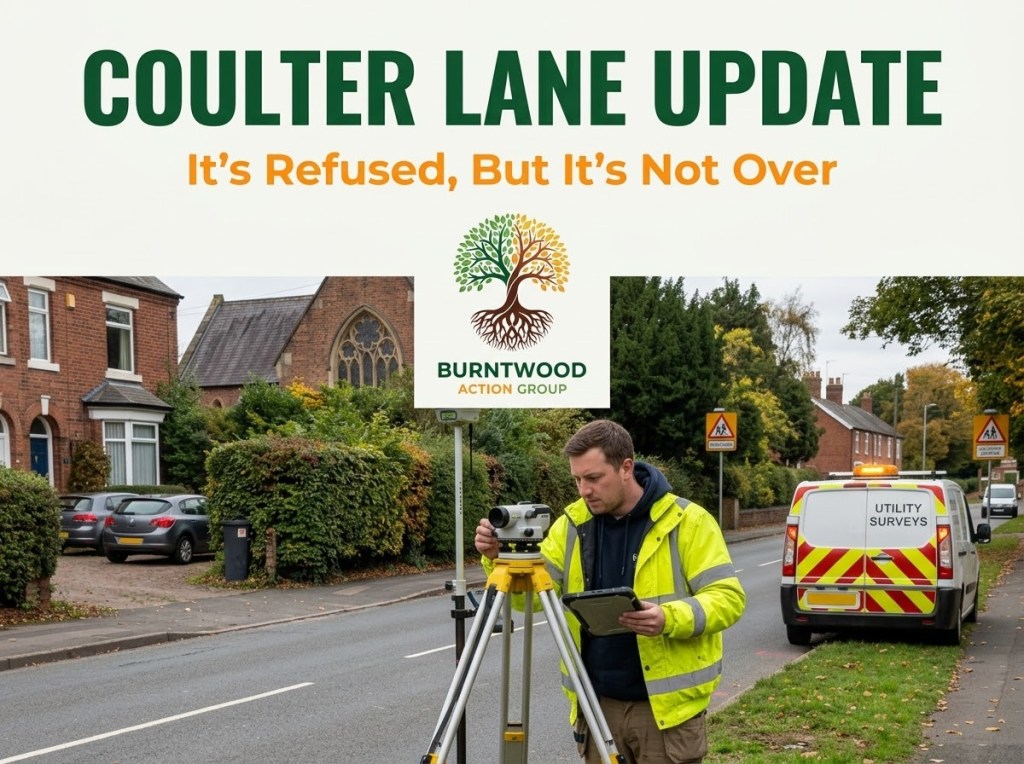
For residents in Burntwood currently watching Bloor Homes’ surveyors plotting levels around Church Road, Princes Park, and Coulter Lane, the view on the ground looks very different from the view in Westminster. Here is a measured look at how the Government’s stated policy compares to the reality of the Coulter Lane Farm application (Ref: 25/01485/OUTM), and how the Burntwood Action Group (BAG) is using these exact national standards to defend our town.

1. “Strict Guardrails” vs. Speculative Applications
The Secretary of State told the committee that under the new regime, a local council must have a mandatory Local Plan “in ahead of any housing or development” to set the criteria for developers.
However, because Lichfield District Council (LDC) is still in the process of finalising its new Local Plan and currently has a 3.5-year housing land supply deficit, developers have been submitting speculative applications on unallocated Green Belt land. Furthermore, while LDC’s 2026 Green Belt Review is only at ‘Stage 1’—with the final ‘Stage 2’ boundary definitions still at least a year away—promoters are already attempting to reclassify open agricultural fields as “Grey Belt”. True plan-led growth means waiting for the completed evidence base and focusing on strategic, self-sustaining locations, rather than forcing piecemeal estates onto the edge of Burntwood before the guardrails are even built.
2. “Planned Housing with Infrastructure” vs. The S106 Gap
While the Secretary of State promised communities that new housing will come with necessary supporting infrastructure, she also candidly admitted to MPs that the traditional Section 106 model (where developers pay for local infrastructure and social housing) is struggling due to economic viability and construction costs.
We saw this exact issue play out during the 20 July 2026 Planning Committee meeting for Coulter Lane. Despite clear local pressures on Burntwood’s GP surgeries, dental practices, and schools, neither the Education Authority nor the Integrated Care Board secured Section 106 expansion funding for the local area in the original officer report. This lack of evidenced capacity was a central reason why our elected councillors rightly voted 9-to-2 to refuse the 250-home proposal.
3. Councillor Powers and the October 31st “Gateway”
The Secretary of State insisted that while minor, routine applications will now be decided by planning officers to speed up the system, “any larger developments or other issues can be called in and will be made by councillors.”
Under the new Town and Country Planning Regulations 2026 (which took effect on 31 October 2026), a major 250-home resubmission falls into “Schedule 2”. Crucially, it does not go to the Planning Committee automatically. Instead, it must pass through a “Week 5 Gateway” assessment where both the Chief Planning Officer and the Planning Committee Chair must jointly agree that the scheme raises significant local environmental, social, or planning issues. If they do not agree, the decision defaults to planning officers.
Our Next Steps: Focusing on Objective Evidence
The Secretary of State repeatedly emphasised that the planning system is now “more objective rather than subjective.” On this point, we completely agree.
Whether Bloor Homes lodges a formal planning appeal (which they have until mid-February 2027 to do) or submits a revised application into the new Gateway system, emotional objections will not win the day. That is why BAG has already lodged a formal Committee Referral Request with LDC, and why we are working alongside our retained planning barrister to prepare for a potential Public Inquiry. By focusing strictly on objective, verifiable facts—such as Swan Island and Church Road traffic capacity, infrastructure deficits, heritage harm to Grade II listed assets, and Green Belt openness—we are ensuring that Burntwood’s defence meets the exact technical standards required by national law.



Leave a Reply