
When Lichfield District Council (LDC) policy officers quietly published their recent housing report, they thought they were securing a neat political compromise with Bloor Homes. They agreed to a revised 43% “affordable housing” package, cutting the developer’s preferred “Discount Market Sale” (DMS) properties down from 15% to 8%.
On paper, the council wants you to think they won. In reality, they’ve just signed off on a corporate checkbox exercise.
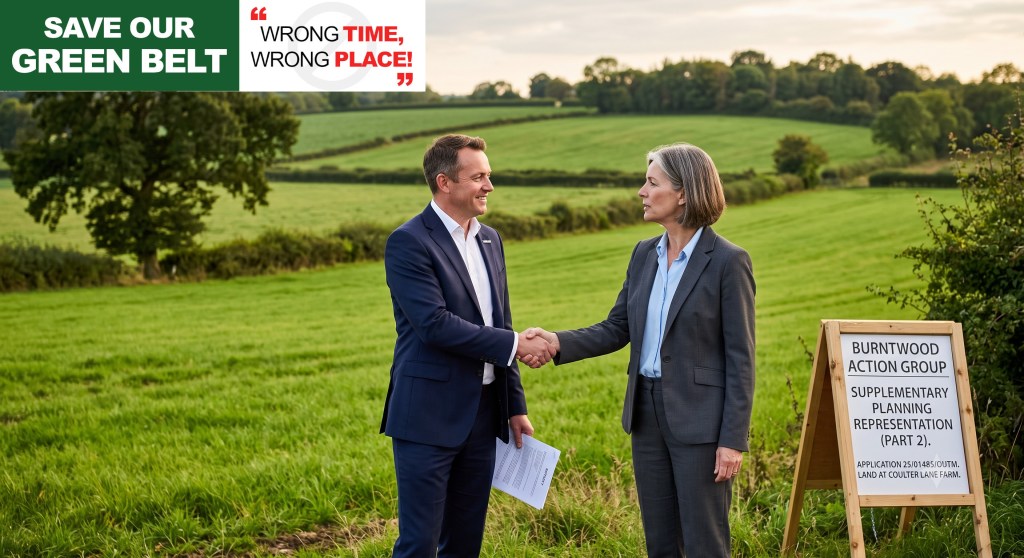
The Burntwood Action Group (BAG) Strategic Policy Team has officially filed an Objection and a Supplementary Planning Representation directly onto Gillian Pinna-Morrell’s active case file. We have exposed the structural failures of this deal.
Here is the unvarnished truth about the three hidden mechanisms behind the 8% DMS loophole—and why it proves the council is prioritising developer paperwork over actual local housing needs.
The Admission LDC Tried to Bury
In the internal report uploaded today, LDC’s own Senior Policy and Strategy Officer made a staggering, written admission about the viability of these low-cost homeownership schemes:
“Recent delivery of Discount Market Sale properties on another scheme in Lichfield in early 2026 showed a lack of demand with only a third of these units being sold to those meeting the local connection criteria and taking the developer longer than expected to sell.”
Read that carefully. Two-thirds (66%) of these properties failed to find a local buyer. Yet, despite their own data proving this model is a total failure for local families, the planning department is still actively negotiating to permit an 8% chunk of it on our green belt.
Here is why these schemes fail local people, and how developers exploit them:
The Three Hidden Traps of the DMS Scheme
💸 1. The Price-Rigging Mechanism (The Valuation Illusion)
The council boasts about securing a “minimum 20% discount” for local buyers. But a 20% discount means absolutely nothing when the developer holds the keys to the baseline valuation.
Developers mask the true cost of these homes by inflating the baseline Open Market Value (OMV). They use premium “new-build markups” (which are already 15-20% higher than older homes on the secondary market) and pull pricing data from affluent district-wide comparables in Lichfield City to artificially hike the price of a house in Burntwood.
By the time they chop their “20% discount” off their inflated baseline, the final price is identical to standard market value. The local buyer isn’t getting a discount; they are just paying the developer’s markup.
🔒 2. The Mortgage Market Lockdown
Why did the council’s 2026 scheme take “longer than expected to sell”? Because high-street banks and mortgage lenders heavily restrict or entirely refuse lending on DMS properties.
Lenders dislike the strict resale covenants locked into Section 106 agreements. Local first-time buyers on normal Burntwood wages are caught in a trap: their income is low enough to qualify for the council’s eligibility cap, but consequently too low for strict lenders to grant a mortgage on an inflated new-build price. The houses sit empty because local people literally cannot get the mortgages to buy them.
🚪 3. The Escape Hatch: The “Cascade Clause” Loophole
This is the ultimate corporate trap. When a developer cannot find a certified local buyer who can secure a mortgage within a short countdown window (usually 12 to 16 weeks), a hidden “Cascade Clause” in the legal contract kicks in.
Once that timer expires, the local connection rules are completely thrown away. The developer is legally allowed to sell those “affordable” units at the discounted rate to anyone in the UK—including out-of-area cash buyers and buy-to-let property investors.
What BAG Has Done Today
While there are 647 households currently on the housing register waiting for genuine social rented housing, our council has spent its week behind closed doors smoothing the path for an 8% corporate loophole that historical data proves will likely end up sold to outside investors.
BAG will not accept this administrative evasion. Our legal submissions makes it clear: It is entirely irrational to permit the permanent destruction of Burntwood’s agricultural green buffer to build a housing product that the council’s own data proves local residents do not want, cannot afford, and cannot buy.
We have forced this technical data onto the record. Now, we need the ground game to match it.
- Read our full, stamped objection letters below.
The fire is burning hot, Burntwood. Let’s keep it moving.



Leave a Reply