
When we look across the beautiful, open fields off Coulter Lane and Church Road today, it’s easy to see them simply as a peaceful green backdrop to our daily lives. But if you could step back into the late 1700s and 1800s, this landscape would have looked, sounded, and felt entirely different.
Beneath the soil of these 56 acres lies the forgotten heart of the ancient Fulfen Hamlet, Burntwood Green. And the secret to understanding how our ancestors worked this land lies in one specific element: water.
The Willow Makers of Burntwood
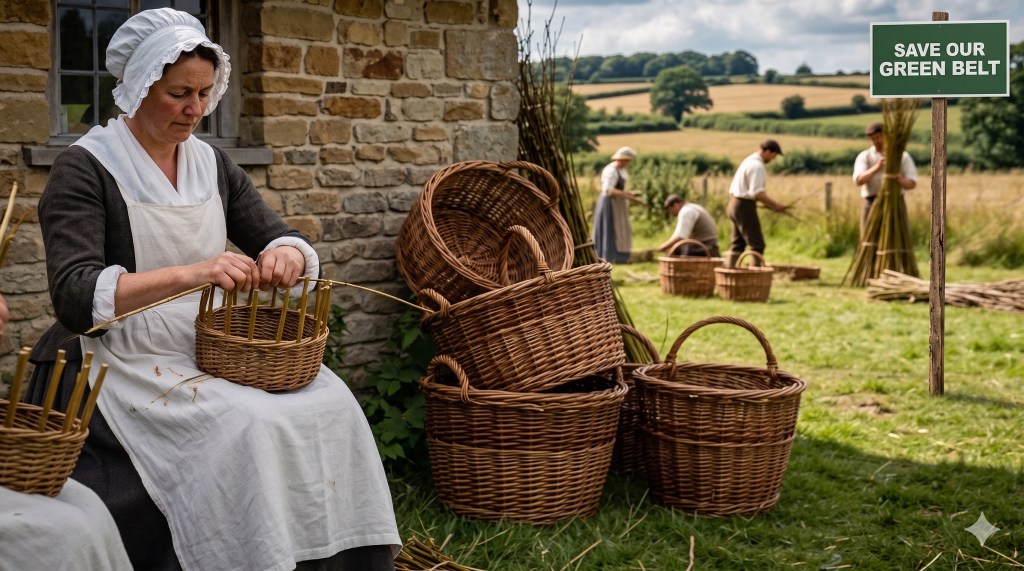
Long before modern drainage systems, local farmers knew that the low-lying parts of the Coulter Lane fields were naturally blessed with high groundwater and rich, peaty soil. Instead of fighting the water, they worked with it by planting Osier Beds—intensive plantations of specialised willow trees.
Willow thrives in waterlogged clay, and back then, it was the “plastic” of the Georgian and Victorian eras. Every winter, local workers would wade into the damp fields to harvest the long, flexible willow rods. These rods were bundled up and taken to local cottages to be woven into baskets, crates, and hampers.
Why was willow making so huge here? Because Burntwood was surrounded by rapidly growing industries. The nearby Cannock Chase coalfields required thousands of incredibly strong, flexible willow “corves” (baskets) to haul coal up from the deep pits. Local pottery from up the road needed willow crates packed with straw to transport delicate ceramics across the country without breaking. The very dampness of the Coulter Lane fields fueled the local economy.
Cottage Forges and Winter Nails
The history of these fields wasn’t just woven; it was forged. During the harsh winter months when agricultural work slowed down, the Fulfen Hamlet became a hub of domestic cottage industry.
Many local families ran small, single-hearth blacksmith forges in their outbuildings. While the willow was being woven nearby, other family members—often including women and children—would sit by the hearth, heating iron rods and hammer-forging thousands of traditional Staffordshire nails. It was a community of incredible resourcefulness, where the land provided the willow, and the cottages provided the trade.
A Landscape Worth Remembering
This is the era when one of Burntwood’s most famous historical residents, Francis Barber—the former enslaved man who became Dr. Samuel Johnson’s legal heir and our town’s first Black schoolmaster—lived and walked right here in the locality. He would have been intimately familiar with the smoke of the cottage forges, the sight of the historic field ponds, and the seasonal rhythm of the willow harvest.
The ancient field boundaries we walk past today are the exact same lines mapped out by those 18th-century weavers and farmers. The Coulter Lane fields aren’t just empty space; they are a living, breathing historical document of Burntwood’s industrial and rural grit.
Next time you walk the footpaths, take a look at the low-lying dips where the ground gets a little soft. You are standing right where Burntwood’s historic willow weavers stood centuries ago.






Leave a Reply