
For months, we’ve been told that the fields at Coulter Lane are just “vacant land” or “scrubland” destined for 250 executive houses. We were told there was nothing there.
They were wrong.
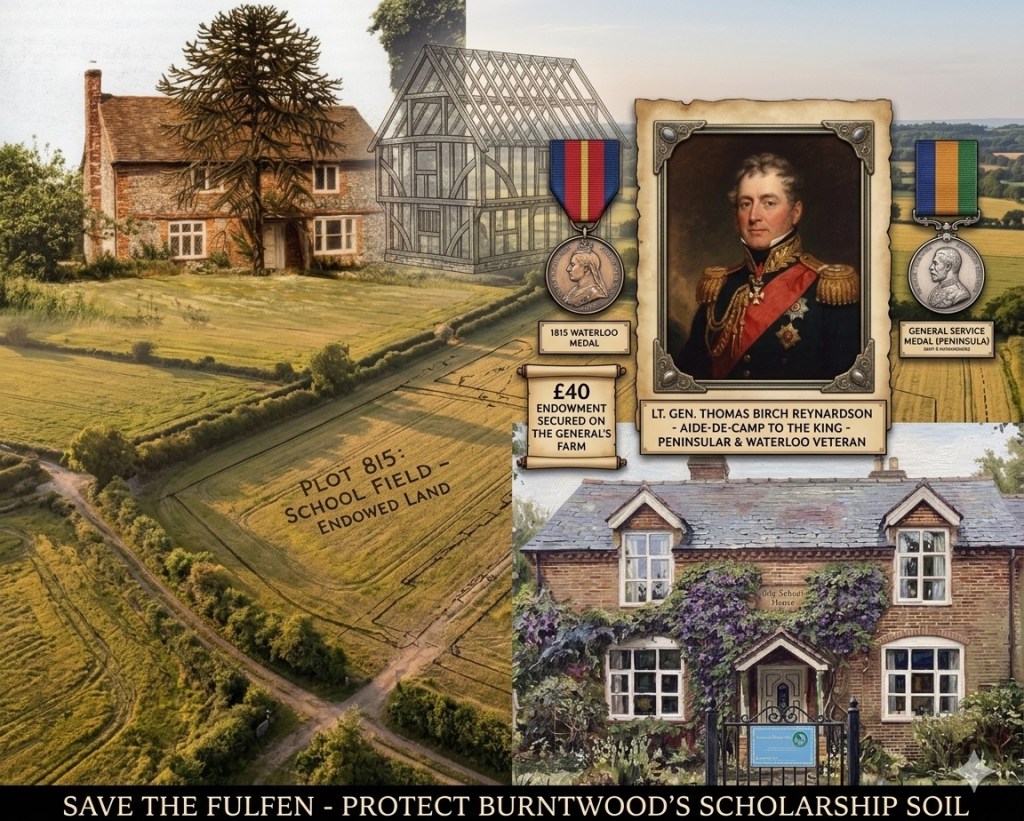
Thanks to a breakthrough discovery in the archives and the original deeds of the Old School House, Coulter Lane, the Burntwood Action Group (BAG) can finally tell the true story of the Fulfen. We aren’t just fighting for green space; we are fighting for the very soul of Burntwood’s “First Village.”
The Vision of Elizabeth Ball & A Global Icon
Our story begins in 1765. While the rest of the country was ignoring the poor, a woman named Elizabeth Ball had a vision. She founded a school to ensure our village children could read and write.
But did you know who taught there? Francis Barber. The man who was the heir to Dr. Samuel Johnson and a figure of international importance in Black British history lived and breathed this landscape. These fields weren’t just a backdrop for him; they were his domestic world. When we protect Coulter Lane, we are protecting a site of global historical significance.
Enter the General: A Hero of Waterloo
By the mid-1800s, the school needed a protector. It found one in Lieutenant-General Thomas Birch Reynardson.
The General was a national hero. He was a veteran of the Peninsular War and stood on the front lines of the Battle of Waterloo in 1815. He was the personal Aide-de-Camp to the King!
When he moved to Fulfen House (now known as Fulfen Farm), he didn’t just sit on his laurels. He took the fields at Coulter Lane—his own private “Home Farm”—and legally tied them to the school. He ensured that the wheat grown on these specific fields paid the wages of our schoolmasters.
The Medieval Secret Under Our Noses
We’ve uncovered that Fulfen Farm isn’t just an old farmhouse. Experts have identified it as a Wealden Hall House.
This is a rare, high-status medieval timber-framed building hiding behind a brick face. It has stood for over 500 years. The Coulter Lane fields are the last surviving piece of the General’s medieval estate. To surround this house with a modern housing estate is to tear a page out of a medieval manuscript.
The “Smoking Gun”: Plot 815
We went to the 1844 Tithe Records, and what we found is the final proof. On the official government maps, one of the fields in the middle of the development site isn’t just a number. It is explicitly named: “The School Field.”
On one side of the site sits Fulfin Cottage, the original village Dame School.
We have found an “Educational Enclave”—a corridor of learning where children went from the Dame School to the Master’s School, funded by the “School Farm” in between. This is the scholarship soil of Burntwood.
Why This Matters Now
The developers want you to think this land is empty. But we now have the 1880 and 1927 Charity Schemes that prove this land was legally “Endowed Property.” It was a gift from a Waterloo General to the future children of this village.
That means us.
We are the beneficiaries of General Reynardson’s legacy. If we allow these fields to be paved over, we are allowing the destruction of a 250-year-old promise.
What Can You Do?
We have submitted this evidence to the Council. We have shown them the General’s medals, the medieval timber of the Fulfen, and the “School Field” on the map.
This is what we sent to the planning case officer this morning (a must read): https://burntwoodactiongroup.org/wp-content/uploads/2026/05/formal-objection_-the-destruction-of-the-general-birch-reynardson-estate-and-the-fulfen-educational-enclave.pdf
Don’t let them ignore it. Share this post.
- Tell your neighbors that we are standing on the estate of a Waterloo Hero.
- Remind the Planning Committee: You can build houses anywhere, but you can only find this history here.
#SaveTheFulfen #TheGeneralsLegacy #BurntwoodHeritage #FrancisBarber #WaterlooHero



 Burntwood Action Group
Leave a comment