
If you walk the fields near Burntwood Green after a heavy rain and feel the ground give way beneath your boots, you are stepping into a very old memory. The land here doesn’t just hold water; it holds history—and according to local resident Deb Scattergood, it holds secrets that some would rather forget.
The Harvest of the “Foul Fen”
Long before the modern era, the area around Fulfen Farm was a landscape defined by water. The name “Fulfen” literally translates to “Foul Fen”—a reference to the boggy, mist-choked marshland that once dominated the valley.
But our ancestors didn’t see a “problem” to be drained; they saw a resource. These were the Withie Fields. Here, the wetland was managed with expert care to grow willow “whips” (withies) for basket weaving.
In an era when Burntwood was a hub for the nailing industry, these baskets were essential for transporting goods to the Black Country. The Nag’s Head and the farmhouse at Fulfen were the heart of this damp, difficult economy. It was back-breaking work in the cloying mud, and at the end of a day spent harvesting in the mist, the workers would retreat to the warmth of the Nag’s Head to wash the chill of the fen from their bones.
The Guardian of the Boundary
Managing a wetland means living with shadows. For centuries, folklore told of Hobstone Hill (the rising ground where St. Matthew’s Hospital once stood). A “Hob” was an earth spirit or goblin, and “Hobstone” was the spirit’s boundary marker.
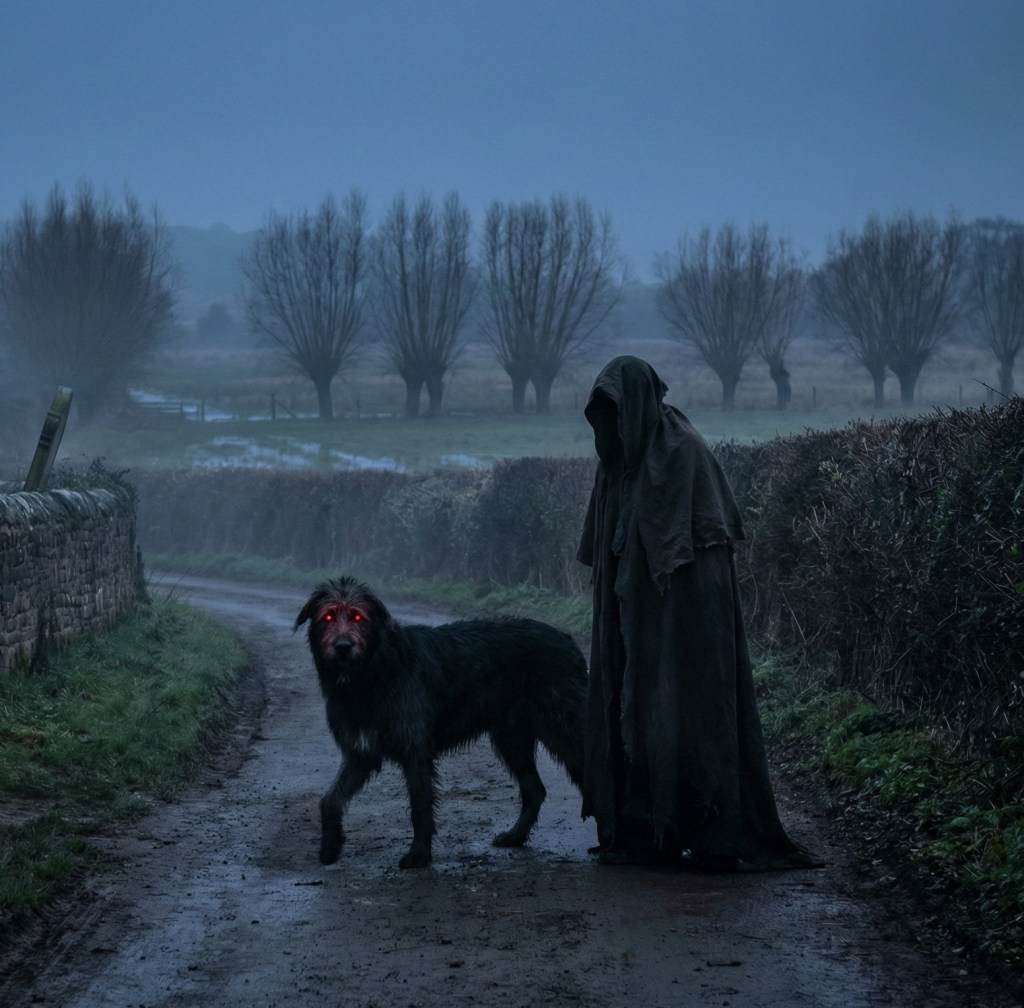
Local legend warned of the Hobhound: a spectral, shaggy black beast with eyes that glowed like burning coals. It was said to patrol the “thin places” where the mist was thickest, acting as a grim guardian of the parish boundaries. Most dismissed it as a “scare tale” to keep children away from the dangerous bogs.
Until the night it was seen.
The Sighting: Allan and Ivan Vinnell
Our old friend and neighbour, Allan Vinnell—a man who knew every inch of this soil—never forgot what he and his older brother Ivan saw one night in the early 20th century.
They were walking up the hill from Woodhouses, alongside the dark perimeter of what is now the cemetery. This was a “boundary path,” an ancient line where the veil was thought to be thin. Suddenly, the silence of the lane was shattered.
Out from the deep shadow of the hedge stepped a creature of nightmare: the Hobhound. It was massive, silent, and its eyes burned with a terrifying, unholy red light. But more chilling still was its companion—a tall, cloaked figure that moved in perfect, ghostly tandem with the beast.
They did not run; they glided. The pair crossed the road from hedge to hedge, following a path that predated any modern map, before vanishing into the gloom toward the fens.
Allan and Ivan fled in a state of sheer terror. The sighting was so vivid and the boys so shaken that their parents reported the encounter to the police. It became a local sensation, appearing in the newspapers as a haunting reminder that the spirits of the Withie Fields were very much alive.
A Heritage Under Threat
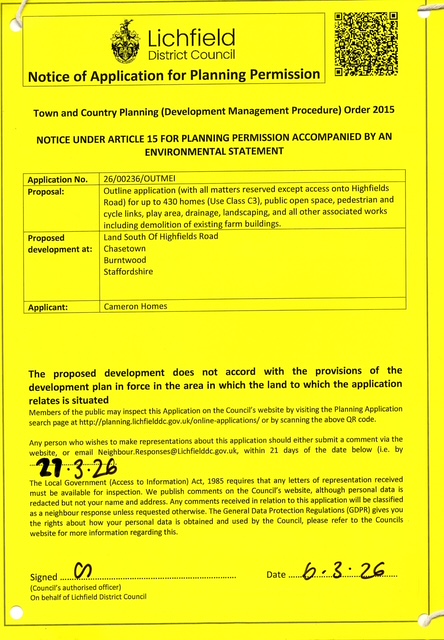
Today, this sacred, storied landscape is facing a new kind of ghost. Bloor Homes is currently seeking to build 250 houses on this very site—a plan that many in our community feel is a total betrayal of our local heritage.
To build a high-density estate on the historic “Foul Fen” is to ignore the natural warnings of the land. You cannot simply pave over a landscape that was designed to be a wetland, nor should we erase the geography that gave us the “Withies” and the legend of the Hobhound.
This land is not just “empty space” for development; it is a living archive of Burntwood’s history, a place of industry, and a place of ancient mystery. As the Vinnell brothers learned that night by the cemetery, some things are meant to be left undisturbed.
Special thanks to Deb Scattergood for sharing these invaluable local histories and keeping the memory of Allan Vinnell and the Hobhound alive.
The Guardians of the Foul Fen Poem
In the hollow of the “Foul Fen,” where the mist begins to bloom, Lies a landscape carved of water, and a history wrapped in gloom. Fulfen’s sodden heartbeat, beneath the Burntwood green, Holds the secrets of the withies, and the things that Allan’s seen.
Where the ground was soft and yielding, the osier beds would grow, Managed by the country hands of centuries ago. They cropped the willow whips—the withies, straight and fine, To weave the baskets for the nails along the county line.
From the hearth of Fulfen Farmhouse to the Nag’s Head down the lane, The industry of wetland bloomed in sunshine and in rain. A balance struck with nature, a rhythm with the mud, Before the dream of concrete chilled the local’s pulsing blood.
But as the sun dipped lower and the shadows started tall, The “Hob” of Hobstone Hill would stir behind the dry-stone wall. A guardian of the boundary, a spirit of the fen, The Hobhound walked the edges, far away from mortal men.
Deb Scattergood recalls the tale of Allan and of Ivan, A memory that the passage of a century couldn’t forge. They walked the hill by the cemetery, where the ancient shadows fell, A night that cast a lingering and a terrifying spell.
Out from the hedge it stepped—a beast of shaggy, spectral height, With eyes like burning embers, glowing red against the night. And by its side, a cloaked companion, silent as the grave, A phantom pair that took the path no living soul would brave.
Hedge to hedge they crossed the road, a stride without a sound, Treading on a trackway long since vanished from the ground. The brothers fled in terror, till they reached their father’s door, And told the police of what they saw—a legend, and much more.
Now Bloor Homes comes with blueprints, and the greed of modern schemes, To pave two hundred fifty houses over local dreams. To drown the fens in tarmac, and to hush the willow’s sigh, Under rooftops crowded close beneath a Staffordshire sky.
But the water won’t be silenced, and the spirits do not sleep, The secrets Deb has shared with us are ours alone to keep. For though they build their houses on the land that once was wet, The Hobhound and the cloaked man… they haven’t left us yet.
 Burntwood Action Group
Leave a comment